There is a moment every year when Hanoi changes its skin. The clammy heat of summer withdraws, the sky clears after months of haze, and the city becomes walkable again. Hanoians have a name for it: mùa thu Hà Nội, Hanoi's autumn. It is their favourite season, the one they have been singing about, painting and photographing for generations — and, quite honestly, the best time of year to discover the Vietnamese capital.
From late September to late November, Hanoi lays out a run of very tangible pleasures: fresh cốm wrapped in lotus leaves, the heady scent of hoa sữa blossom at dusk, almond-tree branches turning orange above Hoàn Kiếm Lake. Here is how to make the most of it, at the right moment and without any nasty surprises.
Why autumn is Hanoi's most beautiful season
Summer in Hanoi is punishing: 35 to 38 °C, humidity close to saturation, storms that flood the streets in twenty minutes. Autumn does exactly the opposite. Temperatures settle around 25 to 30 °C in October, then 18 to 25 °C in November. Humidity drops below 75 %, and rainfall falls to a fraction of what it was in July and August.
The real change is the light. After months of milky skies, the blue comes back. The tree-lined boulevards — Phan Đình Phùng, Hoàng Diệu, Trần Phú — fill with a golden late-afternoon light that completely transforms the mood of the city. In practical terms, it means you can walk for six hours through the Old Quarter without ending up soaked in sweat. In Hanoi, where everything is discovered on foot, that is no small detail: it is the difference between enduring the city and living in it.
When to go: a precise calendar of Hanoi's autumn
Autumn in northern Vietnam does not start on a fixed date. Here is how the season breaks down, week by week.
Late September — The transition. It is still warm (up to 30-32 °C) and the last tropical systems can still track up into the Gulf of Tonkin. This is also the time of Tết Trung Thu and the first cốm of the season. A lovely period, but keep a spare day in your schedule in case of heavy rain.
October — The heart of autumn, and without argument the best month of the year in Hanoi. Clear skies, dry air, 22 to 30 °C. It is also peak tourist season: allow three to four weeks' lead time for Old Quarter hotels and for cruises in Hạ Long or Lan Hạ bay.
November — Cooler (18 to 25 °C, sometimes 16 °C in the evening), quieter, more intimate. Hanoians bring out their light jackets. This is the month of hoa sữa in full bloom, and then, from mid-November, of the cúc họa mi daisy fields around Nhật Tân on the banks of the Red River. Our favourite month if you want to avoid the crowds.
Early December — Autumn fades and the northern winter settles in, with its grey, damp days. The window closes.
Cốm, the taste of a Hanoi autumn
If autumn in Hanoi had a flavour, it would be cốm. These are young glutinous rice grains, harvested before they ripen, gently roasted, pounded and then sifted into tender green flakes, lightly sweet, with a very recognisable grassy fragrance. It is sold wrapped in a lotus leaf, itself bound in a large green leaf and tied with a stalk of rice straw. It is a living product: you eat it within two days, no longer.
Two villages on Hanoi's western edge have made it their speciality for centuries: làng Vòng and Mễ Trì. That is where the street vendors of the city centre stock up every morning, by bicycle or scooter. Expect to pay around 200,000 to 300,000 VND per kilo (roughly 7 to 11 €) depending on quality and the moment in the harvest.
"💬 VietNomads field tip
Real cốm is never a fluorescent green: it leans pale, almost greyish green, and it stays soft under your finger, never dry. Buy it in the morning from a street vendor in the Old Quarter rather than from a souvenir shop, ask for « một lạng » (100 g) to taste, and eat it the way Hanoians do: with your fingers, a few flakes at a time, with a small very ripe banana whose sweetness brings out the fragrance of the rice. Above all, don't put it in the fridge — it hardens immediately.
Cốm isn't only eaten plain. Look out for chả cốm (patties of minced pork mixed with cốm, grilled or fried, often served with bún chả), bánh cốm (a small green cake filled with mung bean paste, the speciality of Hàng Than street), xôi cốm and chè cốm, a sweet cream served warm.
Hoa sữa: the scent that divides Hanoians
From October onwards, something invisible is added to the city. Around 6 pm, a sweet, heavy, almost syrupy scent floods certain streets, strongly enough to stop passers-by mid-step. This is hoa sữa — the blossom of the milk flower tree (Alstonia scholaris), planted in rows throughout central Hanoi.
The most heavily scented streets are Nguyễn Du, along Thiền Quang Lake, along with Quang Trung, Phan Đình Phùng, Thanh Niên avenue between West Lake and Trúc Bạch Lake, and Trích Sài. Flowering usually peaks between mid-October and late November.
An honest warning: not everyone loves this scent, Hanoians included. Too concentrated, it can bring on headaches and breathing discomfort in sensitive people. If that is you, walk in the early afternoon instead, when the smell is far more discreet, and avoid booking a room facing directly onto Nguyễn Du street in November.
Walking the city: our favourite routes
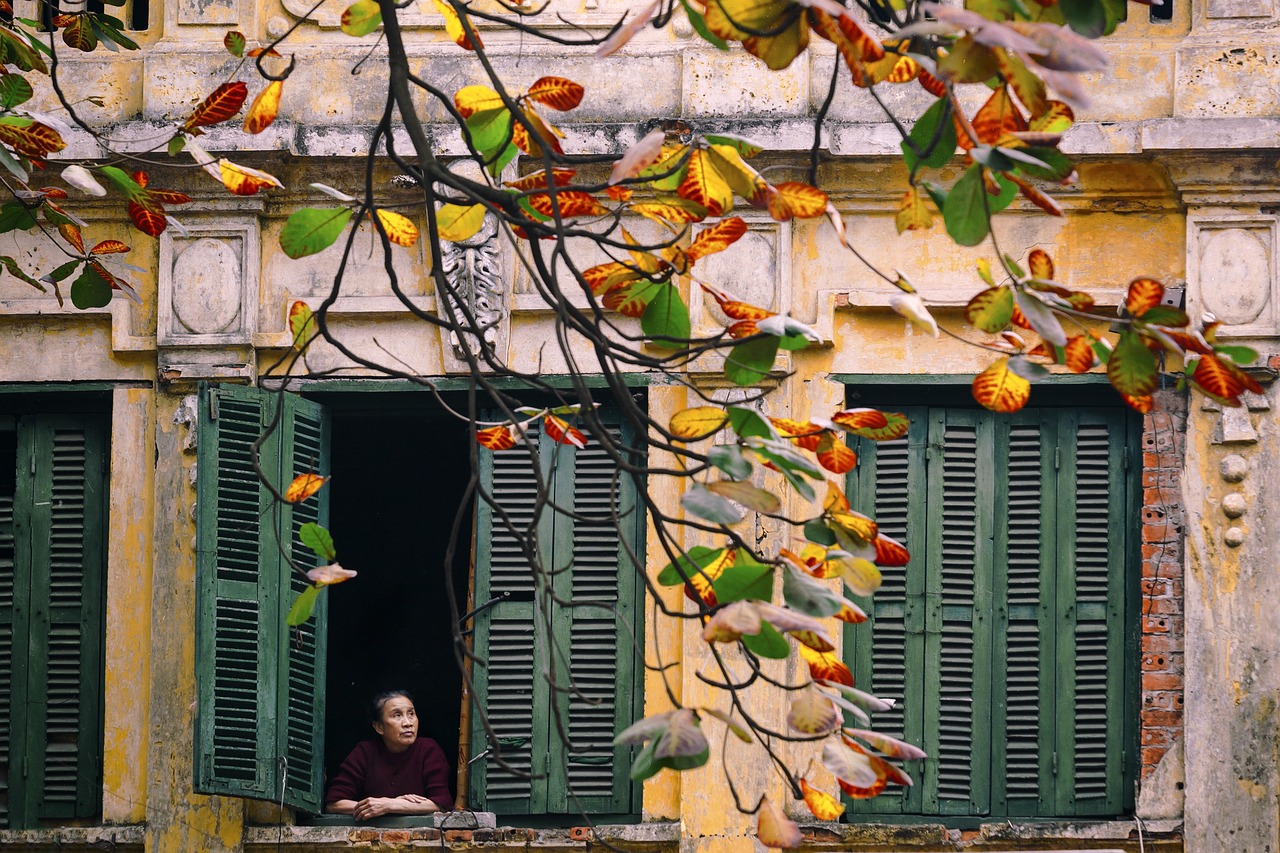
Autumn is made for walking, and Hanoi plays along. These are the three walks we recommend to our travellers every time.
A lap of Hoàn Kiếm Lake at 6 am. This is the hour when the city exercises: tai chi, badminton, group dancing, joggers. The light is low, the air still cool, and you have Thê Húc bridge almost to yourself. Follow it with a phở at a stall in the Old Quarter. From Friday 7 pm to Sunday midnight, the streets around the lake become fully pedestrian — a very different, much livelier atmosphere.
The French Quarter and the Citadel. Starting from Phan Đình Phùng street, one of the most beautiful tree-lined avenues in Southeast Asia, head up to the north gate of the Imperial Citadel of Thăng Long, then back down towards the Temple of Literature. Allow two to three hours including visits. In autumn, the almond trees and old banyans lining Hoàng Diệu filter the light in a way you won't forget.
West Lake at sunset. Thanh Niên avenue separates the large West Lake (Hồ Tây) from little Trúc Bạch Lake. It is the best spot in the city for an autumn sunset, with Trấn Quốc pagoda — the oldest in Hanoi — in the foreground. Finish with a drink on a terrace on the Quảng An side.
What to eat in Hanoi when the temperature drops
Hanoi's cooking is cool-season cooking: lots of broths, hot dishes, things you eat hunched over a plastic stool. Autumn is its moment.
- •Phở bò — Finally enjoyable. A scalding broth at 8 am when it is 20 °C outside is a completely different experience from the same bowl in July.
- •Bún chả — Charcoal-grilled pork, cold rice noodles, sweet-and-savoury broth. Hanoi's signature dish.
- •Ốc nóng — River snails stir-fried with ginger, lemongrass and perilla leaves, picked out with a pin late in the evening. An autumn and winter ritual, impossible to find in high summer.
- •Chả cá — Turmeric-and-dill fish, cooked at your table in a sizzling pan.
- •Cà phê trứng — Hanoi's famous egg coffee, creamy and served hot. A thoroughly autumnal pleasure.
- •Seasonal fruit — Persimmons (hồng), pomelos (bưởi) and thị, those small, intensely fragrant yellow fruits people keep at home for the smell rather than to eat.
Autumn 2026: dates worth knowing
A few fixtures if you are in Hanoi this season.
25 September 2026 — Tết Trung Thu. The Mid-Autumn Festival. Hàng Mã street fills with lanterns from the start of the month and families take over the Old Quarter once night falls.
25 to 27 September 2026 — Festival Thu Hà Nội. Hanoi's big autumn festival, on the Trần Nhân Tông pedestrian street and in Thống Nhất Park, under the theme « Thu Hà Nội – Hành trình cảm xúc » (Hanoi Autumn – A Journey of Emotions). Expect performances, craft workshops, a food village and discovery trails around Hoàn Kiếm Lake and West Lake.
10 October — Capital Liberation Day. Hanoi marks the entry of Việt Minh troops into the city in 1954. It is not a national public holiday, but the city fills with flags and floral displays, and several free exhibitions go up around Hoàn Kiếm Lake.
Mid-November to early December — cúc họa mi season. These small white daisies bloom for just three weeks a year. The fields of Nhật Tân and Quảng Bá, on the banks of the Red River, fill with Hanoian women in áo dài coming to be photographed. A very local moment, and a very beautiful one.
Autumn evenings, when Hanoi lights up
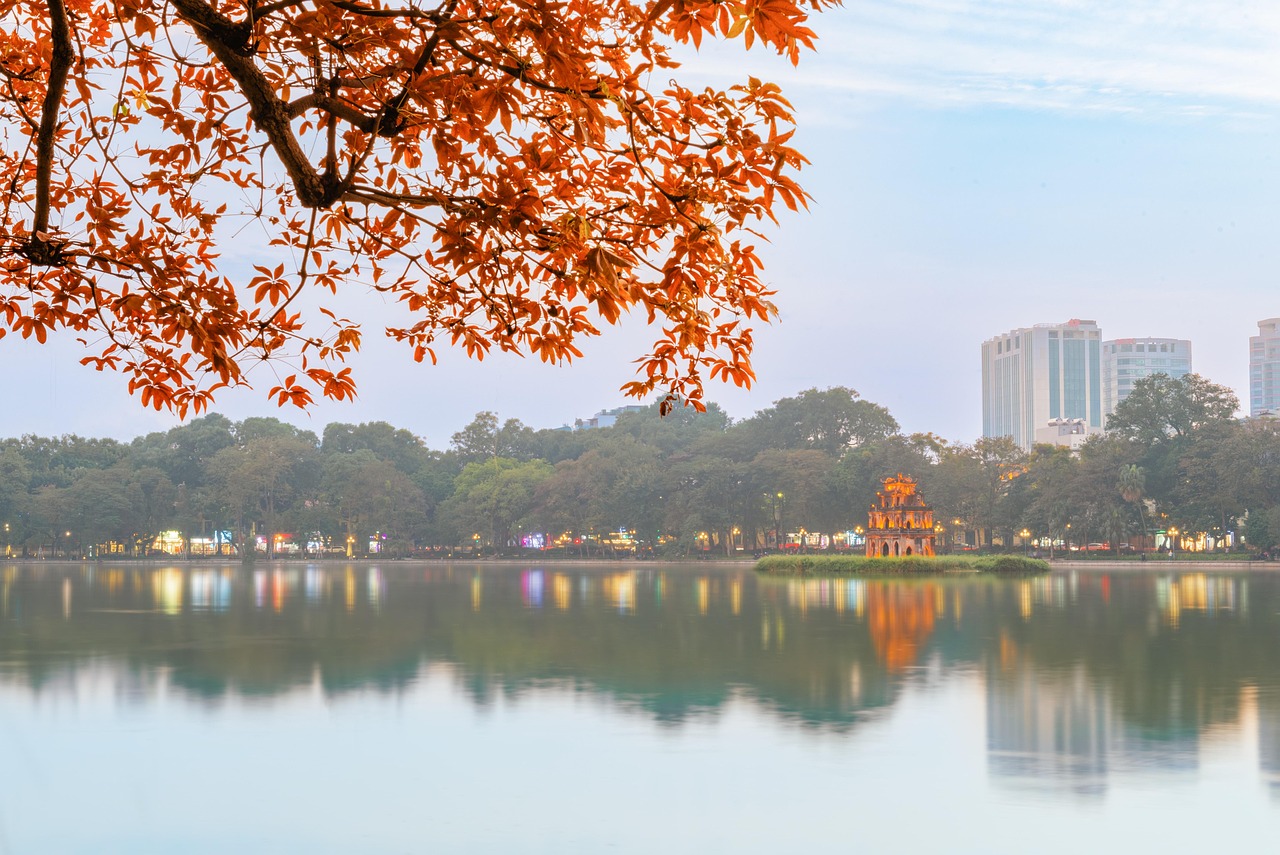
This may well be the best part of the day. Around 6 pm the temperature drops a few degrees, the lights come on around Hoàn Kiếm Lake, and the whole city spills into the street. You sit on a stool for a local draught beer (bia hơi) on the corner of Tạ Hiện street, walk down to the Opera House and the illuminated facade of Tràng Tiền, and finish over a plate of hot snails.
It is also the best moment for hoa sữa, whose scent is released at precisely this hour. Bring a light layer: in November, the gap between mid-afternoon and 9 pm can reach eight degrees.
Packing and planning
Nothing complicated, but the northern autumn calls for more nuance than the south of the country.
- •Late September: summer clothes, plus a light waterproof windbreaker and a folding umbrella. Showers are still possible.
- •October: T-shirt by day, light jacket or long-sleeved shirt in the evening.
- •November: a genuine thin jumper or light jacket, especially for evenings and for excursions in Hạ Long bay, where the wind over the water drops the feels-like temperature fast.
- •All season: good walking shoes. The Old Quarter's pavements are uneven and often occupied by scooters, so you will be walking on the road a lot.
- •Don't forget: sunscreen and sunglasses. The sky is clear and the midday sun still bites in October.
On the planning side, the key point is that October is the busiest month of the year in northern Vietnam. Old Quarter hotels, Lan Hạ bay cruises, night trains to Lào Cai: book three to four weeks ahead, more if your stay falls over a Vietnamese public holiday weekend.
How many days in Hanoi, and what to combine it with?
Three full days strikes us as the minimum for Hanoi: one for the Old Quarter and Hoàn Kiếm Lake, one for the French Quarter, the Citadel and the Temple of Literature, one for West Lake, the craft villages and the markets. Four if you also want time to eat properly — and in Hanoi, taking time over food is part of the sightseeing.
After that, autumn opens up more or less every door in the north:
- •Ninh Bình (2 hours by road): the Tam Cốc rice fields have already been harvested, but the karst cliffs and caves are magnificent in October light.
- •Hạ Long bay and Lan Hạ bay: this is the best weather window of the year, with calm seas and a very low risk of typhoon cancellation from mid-October onwards.
- •Sapa, Y Tý and Mù Cang Chải: the terraced rice fields stay golden until the first days of October, after which the harvest gives way to beautiful late-autumn light.
- •Hà Giang and Cao Bằng: October and November are excellent, with buckwheat flowers blooming across the karst plateau from late October.
- •Pù Luông and Mai Châu: perfect for two quiet nights between stops, with very pleasant temperatures.
In short
Hanoi in autumn is a city that slows down, clears up and finally lets you approach it on foot. Three markers will tell you that you have timed it right: the pale green cốm of the morning vendors, the smell of hoa sữa at dusk, and the almond branches reddening above Hoàn Kiếm Lake.
If you are still hesitating over your dates, aim for the first half of October for the safest weather, or the second half of November for a quieter city and the daisy fields. At VietNomads, we build every itinerary around these seasonal windows: tell us when you can travel, and we will tell you what is at its most beautiful at that precise moment.